Getting in and out of bed can be difficult after back surgery, especially when twisting or pushing up causes pain. A well-fitted bed rail can provide a steady handhold for transfers without replacing the movement guidance from your care team.
These 10 options include compact assist handles, wider rails, and models with support legs. The right choice depends on your bed, your mobility, and how you plan to use the rail.
Best 10 Bed Rails After Back Surgery Picks for 2026
Best Extendable Guard Rail

- 20–30-inch extendable guard rail
- ASTM F3186-17 tested; 300-lb capacity
- Strap and organizer pouch included
Best For: Traditional beds with 10–14-inch mattresses
Best Adjustable Fit

- Adjustable handle, legs, and base width
- 400-lb rating and anti-wobble feet
- Angled foam grip; tool-free setup
Best For: Beds needing a highly adjustable, floor-supported handle
Best Wide Grip

- Wide foam-covered handrail
- 350-lb rating; 16 CFR Part 1270 compliant
- Fits 4–14-inch mattresses
Best For: Compatible full, double, or queen beds needing a broad grip
Best Transfer Handle

- 20-inch-wide padded handle
- ASTM F3186-17 tested; 300-lb capacity
- Tool-free setup; 13-inch floor clearance needed
Best For: Bed entry and transfers to a walker or wheelchair
Compact Transfer Handle

- Adjustable-height padded handle
- Safety strap and tool-free assembly
- Pocket for bedside essentials
Best For: Transfer support on compatible non-articulating beds
Adjustable Reach
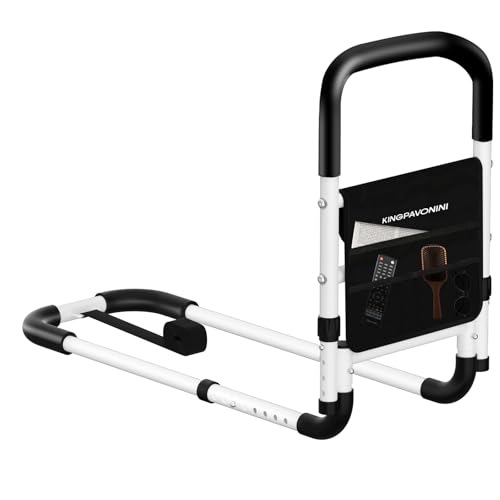
- Adjustable height and horizontal reach
- Angled, foam-padded handle
- Safety belt; stated 350-pound support
Best For: Adjustable grip placement on non-adjustable beds
Floor-Supported Option

- Floor-supported assist design
- Adjustable height and non-slip hand bar
- Strap and removable storage bag
Best For: Adults wanting a floor-supported transfer handle
Best for Low-Profile Mattresses
BigDolphin BS06 Adjustable Bed Rail
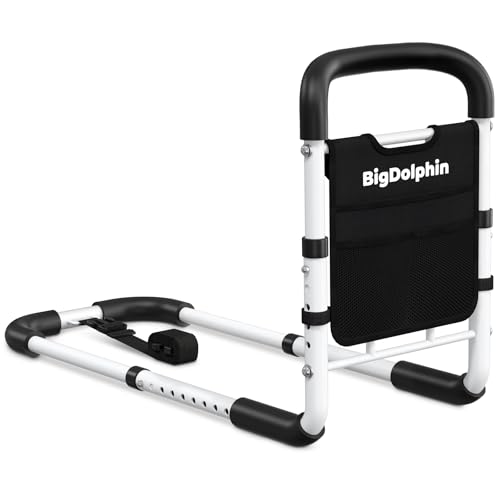
- Fits 2- to 10-inch mattresses
- 350-pound stated capacity
- Curved grip and anchoring strap
Best For: Adjustable support beside a 2- to 10-inch mattress
Best for Thicker Mattresses

- Fits 7.9- to 13-inch mattresses
- 350-pound stated capacity
- Support legs and tie-down straps
Best For: Thicker mattresses on compatible platform or upholstered beds
Best for Uneven Floors
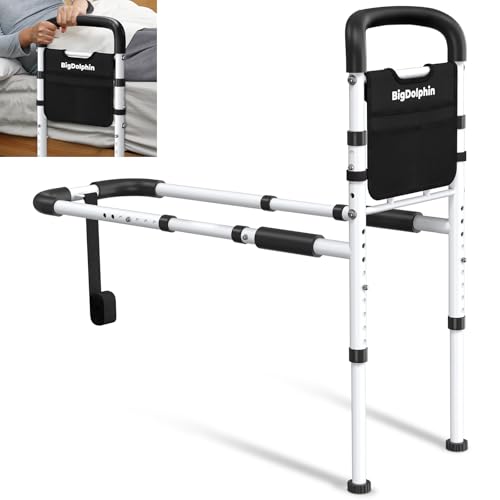
- Spinnable foot addresses small floor gaps
- 350-pound stated capacity
- Adjustable height and horizontal reach
Best For: A bedside handhold where the floor is slightly uneven
Best Extendable Guard Rail – Stander EZ Adjust Bed Rail
For shoppers comparing bed rails after back surgery, the Stander EZ Adjust offers both a bedside assist handle and a guard rail that extends from 20 to 30 inches. Its adjustable length is useful when preventing a roll out of bed matters alongside getting up and repositioning.
Best For: Adults who want an extendable guard rail on a traditional bed with a 10–14-inch mattress.
Pros:
- Passed the ASTM F3186-17 adult portable bed rail safety standard.
- Extends from 20 to 30 inches and supports up to 300 lbs.
- Includes a securing strap and multi-pocket organizer pouch.
Cons:
- Not intended for adjustable or hospital beds.
- Fits only mattresses 10–14 inches thick.
The longer guard-rail setting distinguishes this model from a simple grab handle. Check mattress thickness and bed type before choosing it for a recovery setup.
Best Adjustable Fit – KingPavonini GS04 Bed Rail
Among bed rails after back surgery, the GS04 stands out for its range of fit adjustments: handle height, leg height, and base width can all be changed. Its angled, foam-wrapped handle is designed to provide leverage when getting in and out of bed.
Best For: Adults whose non-adjustable bed needs a height- and width-adjustable assist handle with floor-supported legs.
Pros:
- Offers four handle heights, 11 leg heights, and eight base widths.
- Rated for 400 lbs; includes dual crossbars, a safety belt, and adjustable anti-wobble feet.
- 30° angled, non-slip handle; tool-free setup and removable storage bag.
Cons:
- Not suitable for adjustable beds or frames under 10 inches high.
- Specified mattress range is 3.9–11.8 inches thick.
This is a strong fit-adjustment option, particularly where uneven flooring calls for fine-tuning the feet. Confirm both frame height and mattress thickness before ordering.
Best Wide Grip – Extra-Wide 16-Inch Bed Rail
If a broad place to grip is your priority when shopping for bed rails after back surgery, this extra-wide model pairs a foam-covered handrail with a 25-inch under-mattress section. It is intended for regular household mattresses 4–14 inches thick.
Best For: Adults seeking a wide, padded assist rail for a compatible full, double, or queen bed.
Pros:
- Complies with 16 CFR Part 1270 and has a stated 350-lb capacity.
- Adjustable height of 17.7–21.6 inches, with a foam-covered grip.
- Includes securing straps and a side pocket; assembly requires no tools.
Cons:
- Not compatible with recessed bed frames or adjustable beds.
- Height adjustment uses screw tightening rather than a quick clip.
The wide grip and 4–14-inch mattress range give this rail practical appeal. Verify the bed-frame design first, especially if the mattress sits inside a recessed frame.
Best Transfer Handle – Vaunn Medical Bed Rail
The Vaunn Medical rail is a practical option among bed rails after back surgery when a stable handhold for sitting up or moving from bed to a walker or wheelchair is the main goal. Its 20-inch-wide handle has foam padding, and the frame secures beneath the mattress with a strap.
Best For: Adults using a compatible bed who want a wide assist handle for bed entry, repositioning, and transfers.
Pros:
- Passed ASTM F3186-17 and supports up to 300 lbs.
- 20-inch-wide padded handle and horizontal stabilizer bars.
- Tool-free assembly; installs on either side and includes a storage pouch.
Cons:
- Requires 13 inches of floor clearance and a 7–11-inch mattress.
- Not for motorized adjustable beds or most Sleep Number beds.
This model focuses on a straightforward, wide transfer grip rather than an extendable guard rail. Measure floor clearance as well as mattress thickness to make sure it can be installed as specified.
Compact Transfer Handle – Medline Bed Assist Bar
For shoppers comparing bed rails after back surgery, the Medline Bed Assist Bar offers a padded handhold for getting from sitting to standing. Its adjustable height helps position the grip for your bed.
Best For: Adults who want a compact transfer handle for a non-articulating bed with a 6- to 19-inch mattress.
Pros:
- Padded handle provides a comfortable grip during bed transfers.
- Includes a safety strap and assembles without tools.
- Storage pocket keeps small essentials close by.
Cons:
- Not specified for use with articulating beds.
- Mattress compatibility is limited to the stated 6- to 19-inch range.
This is a practical choice when a handhold matters more than a long bedside barrier. Check your mattress height and bed type before buying.
Among bed rails after back surgery, the KingPavonini BS04 stands out for its adjustable reach and angled, foam-padded handle. The maker specifies support up to 350 pounds, with a safety belt to secure the rail to the bed.
Best For: Adults who want an adjustable transfer handle on a non-adjustable bed.
Pros:
- Height adjusts from 18 to 20.9 inches, and horizontal reach extends from 23.2 to 31.9 inches.
- Expanded chassis, anti-slip foam, and safety belt are designed to reduce movement.
- Tool-free installation and a storage pocket add convenience.
Cons:
- Not compatible with adjustable beds.
- Its stated 350-pound support rating should not be treated as a substitute for proper installation.
The adjustable dimensions make this worth considering when handle placement is a priority. Confirm that its fit range works with your bed before ordering.
For people shopping for bed rails after back surgery, this Medical King rail offers a non-slip hand bar and a floor-supported design for getting in and out of bed. It slides under the mattress and includes a securing strap.
Best For: Adults seeking a floor-supported assist handle with tool-free assembly.
Pros:
- Adjustable height helps position the handle for use.
- Can be installed on either side of the bed, according to the supplied notes.
- Removable bag keeps items such as glasses or a remote nearby.
Cons:
- Not designed for children.
- The supplied notes do not specify a weight capacity.
This option emphasizes straightforward setup and bedside storage. Because the listed fit details are broad, verify the rail’s dimensions against your bed before purchase.
Best for Low-Profile Mattresses – BigDolphin BS06 Adjustable Bed Rail
When comparing bed rails after back surgery, mattress fit matters as much as the handhold. The BigDolphin BS06 fits mattresses 2 to 10 inches high and offers a 30-degree curved, foam-padded grip for getting in and out of bed.
Best For: Someone with a 2- to 10-inch mattress who wants an adjustable bedside handhold.
Pros:
- Reinforced frame is rated to support up to 350 pounds and is described as ASTM-tested.
- Adjusts from 16.9 to 21.3 inches high and extends from 23.6 to 31.5 inches horizontally.
- Includes a safety strap and non-slip foam on the frame to help limit shifting.
Cons:
- Not for adjustable beds.
- Specified mattress range tops out at 10 inches.
The BS06 is a practical fit if your mattress falls within its stated range; check that measurement before choosing it over a rail designed for thicker mattresses.
Best for Thicker Mattresses – Bed Rail with Support Legs
For shoppers looking at bed rails after back surgery, this model is worth considering when the mattress is too thick for lower-profile options. It is specified for 7.9- to 13-inch mattresses and pairs an under-mattress rail with bedside support legs and tie-down straps.
Best For: A 7.9- to 13-inch mattress on a compatible platform or upholstered bed base.
Pros:
- Steel frame has a stated 350-pound capacity and is described as tested to ASTM F3186-17.
- Soft, non-slip foam grip provides a handhold for getting in and out of bed.
- Tool-free setup, tie-down straps, and a mesh pocket add everyday convenience.
Cons:
- Not compatible with recessed bed frames or adjustable beds.
- Mattresses outside the specified 7.9- to 13-inch range are not covered.
Its support-leg design and thicker-mattress range set it apart, but confirm both mattress depth and bed-frame style before ordering.
Best for Uneven Floors – BigDolphin GS07 Bed Rail
Among bed rails after back surgery, the BigDolphin GS07 stands out for its spinnable leg bottom, designed to close small gaps where a floor is not quite level. Its 30-degree curved, padded handle offers a non-slip handhold for sitting up or getting out of bed.
Best For: Someone who wants an adjustable rail with a floor-contact leg for a slightly uneven surface.
Pros:
- Reinforced steel frame has a stated 350-pound capacity and is described as ASTM-compliant.
- Adjusts from 16.5 to 19.7 inches high and extends from 30.3 to 35.8 inches horizontally.
- Spinnable leg bottom helps address small floor gaps; setup is tool-free.
Cons:
- Not for adjustable beds.
- The supplied specifications do not state a compatible mattress-thickness range.
Choose the GS07 for its adjustable reach and floor-contact feature, while checking your bed dimensions and available floor space before purchase.
How We Picked the Best Bed Rails After Back Surgery
We focused on features that matter for post-surgery use: a reachable grip, published weight capacity, mattress and bed-frame compatibility, installation requirements, and whether a rail is designed primarily for transfers or also extends along the bedside. We also considered stated safety-standard claims where provided. A listed capacity or certification does not guarantee safe use on every bed; always check the current manufacturer instructions for the exact model.
Quick Comparison: Which Style Fits Your Needs?
For help standing up, start with a compact assist handle, such as the Medline or Vaunn option, if its height and mounting method suit your bed. If you want a longer handhold along the mattress, consider an adjustable or extra-wide rail, such as the Stander EZ Adjust or the 16-inch model. A rail with bedside support legs may appeal if you prefer a floor-supported design, but measure under-bed clearance first. The GS04, BS04, BS06, and GS07 models list capacities from 350 to 400 pounds; compare their current specifications and fit requirements rather than choosing by capacity alone.
Key Buying Factors for Bed Rails After Back Surgery
Fit and Secure Installation
Measure mattress thickness, bed height, frame type, and available space beside the bed. Check whether the rail works with an adjustable base, platform bed, or box spring if you have one. Follow the required anchoring and strap instructions; do not assume that sliding a rail under the mattress is sufficient. Confirm that the installed handle stays stable when used as directed.
Transfer Support and Comfortable Reach
Choose a grip you can reach from your usual sleeping position without twisting your back. The handle should support the transfer method recommended by your surgeon or physical therapist, not encourage you to pull yourself up in a way that conflicts with movement restrictions. A higher capacity is useful only when the entire rail-and-bed setup is compatible and properly installed.
Entrapment and Fall Risks
Gaps between a rail, mattress, and headboard can create entrapment hazards. Review the manufacturer’s mattress-size limits and applicable safety guidance, particularly for anyone with confusion, reduced sensation, or difficulty repositioning independently. A rail is not a substitute for supervision or a fall-prevention plan.
Who Should Buy Which Bed Rails After Back Surgery?
Choose a compact assist bar if your main challenge is sitting up or standing and you do not need a long bedside rail. Look at an adjustable or wider rail if you need more handhold length and it can be installed without unsafe gaps. Consider a model with support legs when your bed and floor clearance accommodate it. If you need substantial lifting assistance, cannot follow transfer instructions, or are unsure whether a rail is appropriate, ask your care team about safer transfer aids before buying.