Eating independently can become harder when tremors, arthritis, Parkinson’s, or reduced hand strength affect grip and wrist control. The right adaptive silverware can make everyday meals more manageable without adding unnecessary bulk.
We selected 10 lightweight adaptive utensils with features such as built-up handles, bendable designs, angled heads, and optional weighting. Use the guide below to compare the most important differences before choosing a set.
Best 10 Lightweight Adaptive Utensils Picks for 2026
Best Portable Set
BUNMO Foam-Grip Adaptive Utensils

- Soft, lightweight foam handles
- Four-piece set with rocker knife
- Includes reusable canvas travel wrap
Best For: Seniors and adults dining at home or away
Best Customizable Grip
Bendable 4-Piece Adaptive Utensils

- Adjustable fork, spoon, and tablespoon
- Wide ribbed handles support control
- Works for right- and left-handed users
Best For: Users who need a personalized utensil angle
Best Everyday Value
Nourislif Built-Up Adaptive Utensils
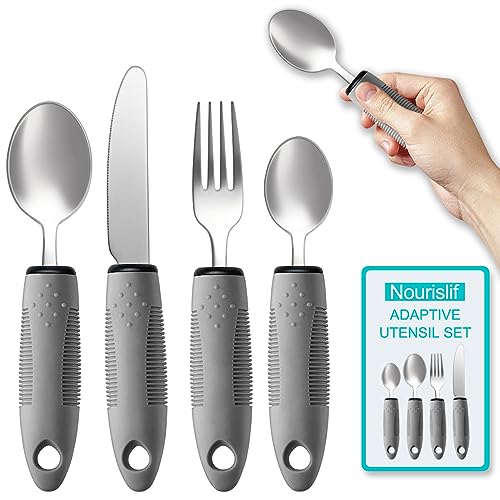
- Wide, contoured 1.25-inch handles
- Lightweight at 2.5 ounces each
- Four pieces with dishwasher-safe steel
Best For: Daily meals for adults needing a wider grip
Best Two-Piece Option
Bendable Curved Fork and Spoon

- Bends up to 180 degrees
- Lightweight textured non-slip grips
- Includes velvet storage pouch
Best For: Users needing a compact fork-and-spoon set
Steady-Grip Weighted Set

- 42° angled design helps reduce wrist rotation
- 2.5 oz weight adds stability for tremors
- Large non-slip silicone handles
Best For: Right-handed users needing weighted, angled support
Discreet Scoop Assist

- Flat edge helps scoop food efficiently
- Non-weighted stainless steel design
- Includes tablespoon and teaspoon
Best For: Users wanting familiar, two-handed spoon support
Everyday Grip Support
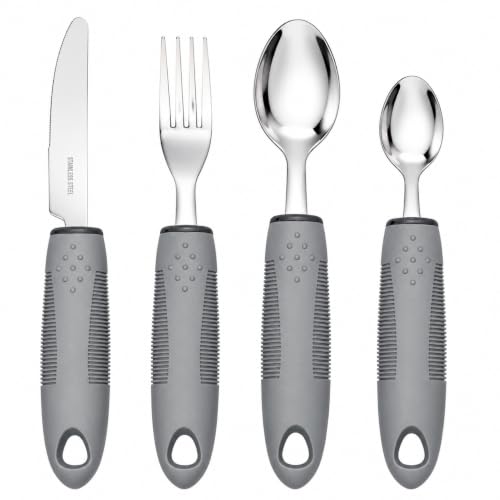
- Ergonomic non-slip handles
- Includes fork, knife, spoon, and more
- Dishwasher-safe food-safe construction
Best For: Users needing general grip and hand-fatigue support
Simple-Grip Stability
Nourislif 3-Piece Adaptive Utensils

- Light 2.7-ounce-per-piece design
- Built-up, easy-grip handles
- Dishwasher-safe stainless steel set
Best For: Adults needing basic grip assistance during meals
Angled Wrist Comfort

- 45-degree angled design
- Weighted textured handles for stability
- Complete four-piece assortment
Best For: Right-handed users who prioritize wrist comfort and control
Lightweight Angled Control
KintKita 4-Piece Adaptive Utensils
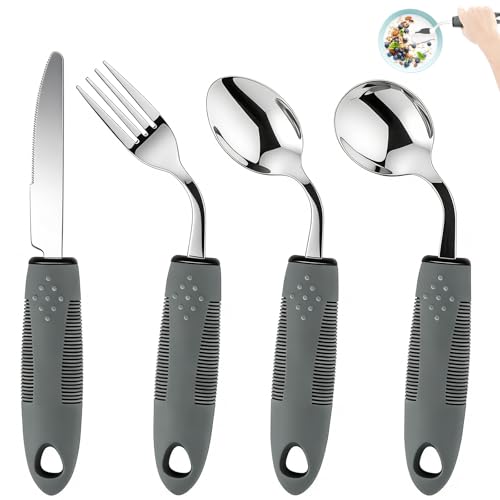
- Approximately 2.5–2.9 ounces each
- 45-degree spoon and fork
- Textured silicone anti-slip handles
Best For: Right-handed users wanting lighter stability and wrist support
Best Portable Set – BUNMO Foam-Grip Adaptive Utensils
For shoppers comparing lightweight adaptive utensils, the BUNMO set combines cushioned foam handles with a practical four-piece collection. Its included canvas wrap also makes it convenient for dining away from home.
Best For: Seniors or adults who want a lightweight, comfortable set for home meals and travel.
Pros:
- Soft, non-slip foam handles are designed to reduce hand strain.
- Includes a fork, tablespoon, teaspoon, and curved rocker knife.
- Reusable canvas wrap keeps the set organized and portable.
- Stainless steel construction is rust resistant and dishwasher safe.
Cons:
- The foam handles may require more care than all-metal handles.
- The set is supplied in one gray color and style.
This is a strong choice when portability matters as much as grip comfort. The rocker knife and travel wrap add useful everyday versatility without making the set cumbersome.
Best Customizable Grip – Bendable 4-Piece Adaptive Utensils
These lightweight adaptive utensils stand out for their adjustable design. The fork, teaspoon, and tablespoon can be bent to suit the user’s preferred position, while the wide ribbed handles support control during meals.
Best For: Right- or left-handed users with arthritis, tremors, Parkinson’s, or reduced grip strength who need a customizable utensil angle.
Pros:
- Three utensils can be bent into a preferred position.
- Wide handles include ribs that align with the palm.
- Designed for both right- and left-handed users.
- Dishwasher safe up to 125 degrees.
Cons:
- The adjustable feature does not apply equally to every utensil; the knife’s ribs fit both hands.
- The listed weight is 15.84 ounces, so it may not feel as light as some alternatives.
Choose this set if positioning is the main challenge. Its bendable components offer more fit flexibility than fixed-handle designs, though shoppers should consider the listed weight before buying.
Best Everyday Value – Nourislif Built-Up Adaptive Utensils
Nourislif offers a straightforward four-piece option for anyone seeking lightweight adaptive utensils with enlarged handles. The contoured, 1.25-inch-wide grips are intended to improve stability while keeping cleanup simple.
Best For: Adults with tremors, arthritis, Parkinson’s, or weak grip who want a dishwasher-safe daily set.
Pros:
- Built-up contoured handles provide a wider gripping surface.
- Lightweight design is listed at 2.5 ounces per utensil.
- Includes a tablespoon, teaspoon, knife, and fork.
- Rustproof stainless steel is dishwasher safe.
Cons:
- The set has a brushed finish rather than a polished finish.
- It does not include a travel case or pouch.
This set keeps the feature list focused on comfortable handling and easy maintenance. It is a sensible everyday pick for users who prefer a conventional four-piece arrangement without added portability accessories.
Best Two-Piece Option – Bendable Curved Fork and Spoon
For shoppers who need only the essentials, this compact pair of lightweight adaptive utensils includes a bendable fork and curved spoon. Both can be adjusted up to 180 degrees to reduce awkward wrist positioning.
Best For: Seniors or disabled adults with limited hand mobility who prefer a small, customizable fork-and-spoon set.
Pros:
- Necks bend up to 180 degrees for a personalized angle.
- Lightweight design is intended to reduce hand fatigue.
- Textured non-slip grips support handling with wet or trembling hands.
- Reversible for right- or left-handed users and dishwasher safe.
Cons:
- Includes only a fork and spoon, not a knife or additional utensils.
- The smaller set may be less suitable for shoppers wanting complete tableware.
This is the most focused option in the group: useful when angle adjustment and low weight matter more than having a full place setting. The included velvet pouch adds convenient storage or gifting appeal.
Steady-Grip Weighted Set – Angled Parkinson’s Utensils
If you need lightweight adaptive utensils with added stability, this four-piece set combines a moderate 2.5-ounce weight with a 42° angled design. The built-up silicone handles are intended to reduce wrist rotation and make gripping easier during everyday meals.
Best For: Adults with Parkinson’s, hand tremors, arthritis, or limited hand mobility who want angled, weighted utensils.
Pros:
- 42° angled design can reduce wrist rotation and fatigue.
- 2.5-ounce weighting provides stability without the bulk of heavier utensils.
- Large textured, non-slip silicone handles support an easier grip.
- Includes a fork, knife, and soup spoon with dishwasher-safe stainless steel eating surfaces.
Cons:
- The weighted and angled design may not suit users who prefer conventional flatware.
- This version is specified for right-handed use.
Choose this set when tremor control and grip support matter more than a minimalist, everyday-flatware appearance. Its combination of moderate weight, angled heads, and large handles is geared toward assisted independence.
Discreet Scoop Assist – Flat-Edge Spoon Set
For shoppers seeking lightweight adaptive utensils that look like normal flatware, this non-weighted stainless steel spoon set focuses on easier scooping rather than a specialized handle. Its flat edge follows the curve of a typical bowl or plate to help gather more food in one pass.
Best For: Users with Parkinson’s, arthritis, weak grip, or limited dexterity who prefer familiar, non-weighted spoons.
Pros:
- Flat-edge spoon design supports more efficient scooping from bowls and plates.
- Non-weighted construction avoids the bulk of heavy weighted handles.
- Works in either hand without requiring a special grip.
- Includes an 8.3-inch tablespoon and a 5.9-inch teaspoon; both are dishwasher safe.
Cons:
- This is a two-spoon set, not a complete fork, knife, and spoon collection.
- It does not provide angled handles or specialized tremor-weighting.
This is a practical choice when discreet, familiar-looking silverware is important. The flat edge addresses scooping difficulty while the non-weighted stainless steel keeps the set simple for daily use.
Everyday Grip Support – Four-Piece Adaptive Utensils
This four-piece option is designed for shoppers comparing lightweight adaptive utensils for weak hand grip or reduced dexterity. Its non-slip ergonomic handles aim to make mealtime more comfortable, while the included fork, knife, and spoon provide a practical everyday assortment.
Best For: Seniors and adults with arthritis, Parkinson’s, stroke recovery, tremors, or other conditions affecting hand strength and motor skills.
Pros:
- Ergonomic, non-slip handles support a more secure grip.
- Designed to reduce hand fatigue during meals.
- Four-piece assortment includes a fork, knife, spoon, and additional utensil.
- Food-safe construction is dishwasher safe for convenient cleanup.
Cons:
- The supplied notes do not specify the utensil weight or handle dimensions.
- It does not list a specialized angle or dedicated tremor-weighting feature.
Consider this set if you want broad, everyday grip assistance without committing to a particular angled or weighted design. It offers a straightforward assortment for users who value non-slip handling and easy cleaning.
Simple-Grip Stability – Nourislif 3-Piece Adaptive Utensils
For shoppers comparing lightweight adaptive utensils, the Nourislif set offers a relatively light 2.7-ounce-per-piece design with built-up handles for easier gripping. It includes a tablespoon, knife, and fork, making it a straightforward option for everyday meals.
Best For: Adults with hand tremors, arthritis, Parkinson’s, weak grip, or dexterity challenges who want a basic, easy-grip set.
Pros:
- Each utensil weighs 2.7 ounces, supporting a lighter feel than heavily weighted alternatives.
- Built-up handles provide a steadier, easier grip.
- Rustproof stainless steel construction and dishwasher-safe care simplify regular use.
- Includes a one-year Nourislif guarantee.
Cons:
- Only three pieces are included, without a teaspoon.
- The notes do not specify whether the set is designed for left- or right-handed use.
This is a practical pick when grip assistance and easy cleaning matter more than specialized angled features or a larger four-piece assortment.
Angled Wrist Comfort – HJGL 4-Piece Right-Handed Set
This HJGL set combines weighted handles with a 45-degree angled design intended to reduce wrist movement. While not the lightest option in this roundup at 11.2 ounces for the set, it offers a complete four-piece assortment and textured stainless-steel handles for added control.
Best For: Right-handed users with tremors, arthritis, Parkinson’s, neuropathy, reduced grip strength, or post-stroke rehabilitation needs.
Pros:
- 45-degree design is intended to improve wrist comfort and guide food toward the mouth.
- Weighted, textured handles provide tactile feedback and help prevent slipping.
- Includes fork, knife, tablespoon, and teaspoon.
- Dishwasher-safe, food-grade stainless steel construction.
Cons:
- This listing is specifically the right-handed version.
- Its weighted construction may not suit shoppers seeking the lightest possible utensils.
Choose this set when angled positioning and stability are higher priorities than minimum weight; left-handed users should select the corresponding left-handed version if available.
Lightweight Angled Control – KintKita 4-Piece Adaptive Utensils
The KintKita set is a strong match for shoppers seeking lightweight adaptive utensils with added stability. Each piece weighs approximately 2.5 to 2.9 ounces, while the 45-degree spoon and fork, oversized silicone handles, and dishwasher-safe stainless steel construction support comfortable daily use.
Best For: Right-handed seniors and adults with tremors, Parkinson’s, arthritis, weak grip, or stroke-recovery needs.
Pros:
- Approximately 2.5 to 2.9 ounces per utensil balances stability with a lighter feel.
- 45-degree angled spoon and fork are designed to ease wrist strain and reduce movement.
- Oversized, textured silicone handles provide traction and control.
- Four-piece set includes a fork, knife, spoon, and additional utensil, and is dishwasher safe.
Cons:
- Designed for right-handed use.
- The notes do not identify the exact fourth utensil.
For users who want a lighter weighted design without giving up angled positioning or a non-slip handle, KintKita offers one of the more balanced combinations in this selection.
How We Picked the Best Lightweight Adaptive Utensils
We focused on the features that most directly affect comfort and control: overall weight, handle thickness, grip texture, utensil angle, adjustability, piece count, and suitability for common needs such as hand tremors or weak grasp. We also considered whether each design appears practical for daily meals, cleaning, and use with standard plates and bowls.
Because hand strength and movement patterns vary widely, no single utensil style works for everyone. Lightweight models may reduce fatigue, while weighted or angled utensils can provide more stability for some users.
Quick Comparison
| Design | Best suited for | Potential advantage |
|---|---|---|
| Built-up foam handles | Weak grips or arthritis | Requires less finger strength |
| Bendable heads | Limited wrist movement | Can be positioned for a more natural reach |
| Angled utensils | Parkinson’s or reduced wrist control | Helps align the utensil with the mouth |
| Lightly weighted models | Some hand tremors | May improve stability during movement |
| Non-weighted flat-edge spoons | Users needing a lighter option | Reduces load and may help with fatigue |
Key Buying Factors for Lightweight Adaptive Utensils
Weight and Balance
Lightweight Adaptive Utensils are often easier to lift, especially for users with limited arm strength or fatigue. However, a modest amount of weight can sometimes dampen tremors. Compare the listed weight per utensil and consider whether the user struggles more with lifting or with steadiness.
Handle Size and Grip
Thick, cushioned handles are generally easier to hold than slim metal shafts. Look for a diameter that fills the hand comfortably without requiring a tight squeeze. Textured or soft foam surfaces may also help prevent slipping.
Angle and Adjustability
Angled heads can reduce the wrist rotation needed to bring food to the mouth. Bendable models offer more customization, but they may need occasional repositioning. Choose the simplest design that matches the user’s range of motion.
Utensil Selection and Care
A four-piece set usually includes a fork, teaspoon, tablespoon, and knife, while smaller sets may be useful for travel or replacing only the utensil that causes difficulty. Check cleaning instructions, handle construction, and whether the design is suitable for regular dishwasher use.
Who Should Buy Which Lightweight Adaptive Utensils?
Choose built-up lightweight handles for weak grips, arthritis, or users who tire quickly while holding standard silverware. Consider bendable utensils when wrist flexibility or positioning is the main challenge. Angled sets may be preferable for users with Parkinson’s or limited wrist control, while lightly weighted designs can suit people who need extra steadiness during tremors.
If the user is unsure whether added weight helps, start with a lighter or non-weighted model and compare comfort during a typical meal. For significant swallowing, coordination, or motor-control concerns, an occupational therapist can help match utensil design and weight to the user’s abilities.