A raised doorway threshold can make everyday movement difficult for wheelchair users, scooter riders, walker users, and anyone pushing a heavy cart. The right ramp creates a smoother transition while helping reduce jolts, strain, and accidental catches.
This roundup compares 10 threshold ramps for home use across several rise heights, materials, widths, load capacities, and installation styles so you can match a ramp to your doorway and mobility needs.
Best 10 Threshold Ramps for Home Use Picks for 2026
Best Heavy-Duty Rubber Pick

- Wide 35.5-inch rubber design
- Grooved non-slip surface
- Stated 2,200-pound capacity
Best For: Heavy-duty doorway and garage transitions
Best Adjustable Aluminum Pick

- Six height options from 1 to 6 inches
- Splits or expands to 31.5 inches wide
- Textured aluminum with anti-skid underside
Best For: Flexible access across varied steps and thresholds
Best Two-Piece Low-Rise Pick

- Gentle 1.6-inch rise
- Two solid rubber ramp pieces
- Textured surface for everyday traction
Best For: Low thresholds in homes, garages, and sheds
Heavy-Duty Pick
Pyle 3-Inch Rubber Threshold Ramp

- 3,300-pound load capacity
- Non-slip rubber surface and feet
- Tool-free setup with optional hardware
Best For: Heavy-duty indoor or outdoor access
Lightweight Doorway Option
Nuvium Aluminum Threshold Ramp

- 10.5-pound portable aluminum build
- 700-pound load capacity
- Designed for rises up to 4.5 inches
Best For: Portable home entryway access
Cable-Covering Ramp
VEVOR 4-Inch Rubber Threshold Ramp
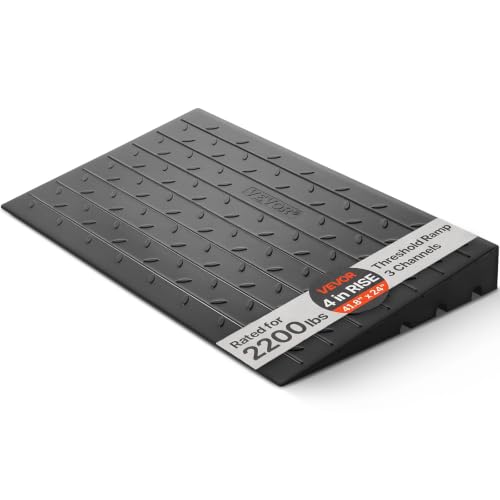
- 2,200-pound load capacity
- Three channels cover cables and hoses
- Heavy 65-pound body resists shifting
Best For: Garages, driveways, and cable-filled transitions
Best Overall Value
1-Inch Cut-to-Fit Rubber Threshold Ramp

- 2,000-pound capacity for mobility equipment and carts
- Grooved surface adds traction in wet or dry conditions
- Trim-to-fit design with included adhesive strips
Best For: Low 1-inch thresholds and customizable home entry transitions
Best Simple Pick
VEVOR 1.6-Inch Solid Rubber Threshold Ramp

- 1.6-inch rise for taller threshold transitions
- 35.4-inch cuttable width for flexible fitting
- Anti-slip surface and double-sided tape included
Best For: High-load doorways, garages, tile, and 1.6-inch thresholds
Best Easy-Install Option
1.6-Inch Adhesive Rubber Door Ramp

- Self-adhesive backing simplifies installation
- Deep grooves add traction and drainage
- Trim or splice pieces for custom doorway coverage
Best For: Quick home-entry installation for wheelchairs, walkers, and strollers
Best Heavy-Duty Rubber Pick – 3-Inch VEVOR Threshold Ramp
For shoppers comparing threshold ramps for home use, the VEVOR 3-inch model stands out as a substantial one-piece rubber option for doorways, garages, gardens, and other uneven transitions. Its beveled edges and grooved surface are designed to make entry smoother for wheelchairs, scooters, carts, and household vehicles.
Best For: Heavy-duty indoor or outdoor transitions where a wide, solid rubber ramp and high stated load capacity are priorities.
Pros:
- Wide 35.5-inch ramp accommodates wheelchairs up to 26.8 inches wide.
- Beveled edges provide approaches from multiple sides.
- Grooved rubber surface adds traction, while the one-piece design needs no assembly.
- Supports a stated 2,200-pound load capacity.
Cons:
- At about 29 pounds, it is less convenient to move than lighter modular ramps.
- The solid rubber construction may have a slight rubber smell.
- Its fixed 3-inch height is less adaptable than adjustable options.
This is a practical choice when durability, broad coverage, and a high load rating matter more than portability or height flexibility. The one-piece format also makes it straightforward for temporary or semi-permanent access.
Best Adjustable Aluminum Pick – Nuvium 3-Inch Modular Ramp
The Nuvium is a flexible option for shoppers seeking threshold ramps for home use that can adapt to different entry heights and widths. Its modular aluminum panels can be configured for six height options, while included connectors allow a narrow or wider setup for wheelchairs, scooters, bikes, cars, and pets.
Best For: Households that need a configurable ramp for multiple doorway, step, curb, or driveway situations.
Pros:
- Offers six height options from 1 to 6 inches.
- Can extend to 31.5 inches wide or separate into 15.75-inch sections.
- Aluminum alloy construction is corrosion-resistant and rated for 1,100 pounds.
- Anti-slip grooves, textured strips, and an underside mat support traction and stability.
Cons:
- Its modular assembly requires more setup than a one-piece ramp.
- The aluminum design has a lower stated capacity than some heavy-duty rubber models.
- The listed ramp dimensions are limited to a 12.5-inch length and 3-inch height for this configuration.
Choose this model when adjustability is more valuable than a simple fixed design. The separable panels and multiple height configurations make it especially useful for changing access needs around the home.
Best Two-Piece Low-Rise Pick – iCAGY 1.6-Inch Rubber Ramps
For lower thresholds, the iCAGY two-piece set offers a gradual 1.6-inch transition in a solid rubber format. These threshold ramps for home use are sized for doorways, garages, sheds, and entry areas, helping carts, walkers, scooters, and wheelchairs pass over modest raised edges.
Best For: Low door thresholds and entry transitions where a gentle rise and two separate ramp pieces are useful.
Pros:
- Low 1.6-inch rise creates a gradual transition.
- Two-piece package can provide coverage for separate access points.
- Textured rubber surface is designed for grip and daily indoor or outdoor traffic.
- Suitable for wheelchairs, scooters, carts, garages, sheds, and entryways.
Cons:
- The fixed 1.6-inch height will not suit taller thresholds.
- Each ramp is only 9.8 inches wide, so users should verify wheel clearance.
- Rubber is heavier than many plastic alternatives, with the set weighing 15 pounds.
This set makes sense for modest height differences rather than tall steps or curbs. Its low angle and grippy rubber construction favor smooth everyday transitions, while the two-piece format adds practical placement flexibility.
Best Modular Plastic Pick – HOXWELL 2-Inch Threshold Ramps
The HOXWELL set is a modular choice for threshold ramps for home use, combining detachable solid plastic sections with 1-inch and 2-inch height configurations. Its pieces can be arranged at 16 or 32 inches wide, making it suitable for different thresholds and access points while remaining lighter than many rubber ramps.
Best For: Indoor users who want a lightweight, adaptable ramp with cable channels and a high stated load capacity.
Pros:
- Configures to 1 or 2 inches high and 16 or 32 inches wide.
- Honeycomb tread pattern is designed to improve slip resistance and shed water.
- New solid plastic construction is described as odor-free and suitable for indoor use.
- Supports a stated 3,000-pound load capacity and includes cable channels.
Cons:
- Bolts are not included for the bolt-hole installation method.
- The 2-inch configuration may not cover taller thresholds.
- Assembly or vertical stitching is needed to change the width or height.
HOXWELL is a strong fit when a lighter, modular design is preferable to heavy rubber. Its configurable footprint and built-in cable channels add useful flexibility around indoor doorways, though installation hardware may need to be sourced separately.
Heavy-Duty Pick – Pyle 3-Inch Rubber Threshold Ramp
For shoppers comparing threshold ramps for home use, the Pyle 3-inch model stands out for its exceptionally high weight rating and grippy rubber construction. It is ready to use indoors or outdoors and accommodates several types of mobility equipment.
Best For: Wheelchairs, scooters, walkers, strollers, and bikes needing a sturdy 3-inch transition.
Pros:
- Supports up to 3,300 pounds.
- Textured non-slip surface and bottom feet help keep it in place.
- Tool-free setup, with hardware included for optional permanent installation.
- Built-in drainage holes and reflective safety stickers are included.
Cons:
- At 21.4 pounds, it is less convenient to carry than lighter aluminum options.
- The 3-inch height may not match taller thresholds.
This is a strong choice when stability, durability, and a very high load capacity matter more than minimal carrying weight.
Lightweight Doorway Option – Nuvium Aluminum Threshold Ramp
Among threshold ramps for home use, this aluminum doorway ramp is a practical option for shoppers who want easier handling and a gradual approach. Its 19-inch ramp surface is designed for thresholds up to 4.5 inches, subject to measuring the rise and landing space first.
Best For: Home entryways, low steps, and users who need a portable ramp for wheelchairs, power chairs, scooters, walkers, carts, or hand trucks.
Pros:
- Lightweight 10.5-pound aluminum construction.
- Supports up to 700 pounds.
- Longer surface provides a more gradual transition than the 15.4-inch model.
- No complicated installation or assembly is required.
Cons:
- It has a lower load capacity than the rubber alternatives in this roundup.
- Fit depends on accurately measuring the threshold height and available landing space.
This ramp makes sense for portable doorway access when manageable weight and a corrosion-resistant aluminum build are priorities.
Cable-Covering Ramp – VEVOR 4-Inch Rubber Threshold Ramp
This VEVOR model is one of the more substantial threshold ramps for home use, combining a 4-inch rise with a wide rubber platform and built-in cable channels. Its heavy weight helps resist shifting, but the steep approximately 14-degree incline requires assisted wheelchair use.
Best For: Doorways, garages, driveways, curbs, and other areas where cable or hose protection and a high load rating are useful.
Pros:
- Supports up to 2,200 pounds.
- Raised-button rubber surface provides slip resistance.
- Three channels accommodate wires, cables, and hoses.
- One-piece, no-tool design stays firmly in place due to its 65-pound weight.
Cons:
- Its 65-pound weight makes repositioning difficult.
- The approximately 14-degree incline is not recommended for people with severe mobility impairments using a wheelchair independently.
- Its 4-inch rise may be more ramp than needed for lower thresholds.
Choose this model when a broad, exceptionally stable ramp with cable management is more important than portability or a gentle incline.
Best Overall Value – 1-Inch Cut-to-Fit Rubber Threshold Ramp
For shoppers comparing threshold ramps for home use, this 1-inch rubber model offers a practical way to smooth low door sills and entry transitions. Its 35.5-inch width can be trimmed for narrower openings, while included adhesive strips help limit movement on clean, dry, smooth surfaces.
Best For: Low indoor or outdoor thresholds used by wheelchairs, power chairs, scooters, carts, bicycles, or robot vacuums.
Pros:
- Supports up to 2,000 pounds.
- Deep grooves provide traction in wet or dry conditions.
- Can be cut to fit or positioned side by side for wider openings.
- Works indoors and outdoors and includes double-sided adhesive strips.
Cons:
- Designed for a 1-inch rise, so it may not suit taller thresholds.
- A mild rubber odor or slight curve may appear after packaging and may require airing out and flattening.
This is a flexible, straightforward option when the threshold height is close to 1 inch and customization is useful. Measure the rise before ordering, and use the adhesive only on suitable clean, dry surfaces.
Best Simple Pick – VEVOR 1.6-Inch Solid Rubber Threshold Ramp
This VEVOR ramp is a heavy-duty choice among threshold ramps for home use, with a 1.6-inch rise and a 35.4-inch width. The solid natural-rubber construction is designed for substantial loads, while its cuttable profile can be adapted to different threshold widths.
Best For: Higher 1.6-inch thresholds, doorways, garages, smooth tile, and areas used by wheelchairs, carts, strollers, or robot vacuums.
Pros:
- Rated for up to 33,069 pounds according to the supplied specifications.
- 35.4-inch width can be cut to fit different openings.
- Anti-slip stripes improve friction and traction in wet conditions.
- Includes double-sided tape for placement on floors or smooth tile.
Cons:
- At 13.7 pounds, it is heavier than a lighter-duty threshold ramp.
- Its 1.6-inch rise may be too tall for a lower threshold.
- The rubber may have a slight smell after unpacking and may benefit from ventilation.
The VEVOR stands out when load capacity and a taller rise matter most. Confirm the 1.6-inch measurement and available width before cutting, especially if the ramp will be used at a smooth-tile entrance.
Best Easy-Install Option – 1.6-Inch Adhesive Rubber Door Ramp
For threshold ramps for home use that prioritize quick installation, this 1.6-inch rubber ramp uses a self-adhesive backing instead of nails, screws, or glue. Its grooved surface is intended to improve traction, and the ramp can be trimmed or joined with additional pieces for different doorway widths.
Best For: Home entrances and doorways used by wheelchairs, walkers, scooters, strollers, seniors, children, or pets.
Pros:
- Supports up to 1,500 pounds.
- Self-adhesive backing allows quick placement without fasteners.
- Deep grooves provide traction and drainage channels for indoor or outdoor use.
- Can be trimmed or spliced with additional ramps for wider openings.
Cons:
- The supplied dimensions are listed as 12 by 5 by 12 inches, so verify the actual fit for your doorway.
- Its 1.6-inch rise may not match lower thresholds.
- Adhesive installation is best suited to a properly prepared surface.
This model is a convenient pick for users who want a simple, adaptable threshold transition. Check the threshold height and opening dimensions first, then ensure the installation surface is suitable for the adhesive backing.
How We Picked the Best Threshold Ramps for Home Use
We compared the selected ramps by threshold height, usable width, surface traction, weight capacity, portability, installation requirements, and overall suitability for common residential doorways. We also considered whether a ramp is better suited to temporary use, permanent placement, indoor access, outdoor exposure, or high-traffic entrances.
Because doorway dimensions and mobility equipment vary, no single design is ideal for every home. Measure the threshold first, then compare the ramp’s rise, width, slope, and clearance before buying.
Quick Comparison
| Ramp type | Best for | Main advantage | Potential trade-off |
|---|---|---|---|
| Rubber | Most standard doorways | Stable, quiet, and often tool-free | Heavy and less convenient to move |
| Aluminum | Portable or temporary access | Lightweight and easy to carry | May shift without careful positioning |
| Modular plastic | Custom or repeated setups | Detachable and adaptable | Requires closer fit and placement checks |
| Cuttable rubber | Nonstandard doorway widths | Can be trimmed for a better fit | Cutting must be accurate |
| Cable-channel ramp | Doorways with cords or cables | Helps route cables across the transition | Usually bulkier than a basic ramp |
Key Buying Factors for Threshold Ramps for Home Use
Measure the Rise and Available Width
Measure from the lower floor surface to the top of the threshold, not just the visible vertical edge. Choose a ramp designed for that exact rise or slightly above it without creating an unstable lip. Confirm that its width fits between the door frame, walls, and trim. Wider models can provide more steering tolerance for wheelchairs and scooters.
Check Slope, Traction, and Load Capacity
A higher threshold generally needs a longer ramp surface for a gentler approach. Look for a textured or non-slip surface, particularly near exterior doors where moisture may be present. The listed weight capacity should exceed the combined weight of the user, wheelchair or scooter, and any carried items.
Choose the Right Material and Installation Style
Rubber ramps tend to stay put and absorb sound, while aluminum models are easier to transport. Modular ramps may offer useful flexibility, and cuttable designs can help with unusual doorway widths. Check whether the ramp is intended for indoor, outdoor, or both environments, and verify that the door can open without contacting it.
Who Should Buy Which Threshold Ramps for Home Use?
- For a typical residential doorway: Choose a rubber ramp matched closely to the threshold height.
- For wheelchair or scooter users: Prioritize sufficient width, a manageable slope, strong traction, and a generous load rating.
- For renters or temporary access: An aluminum or lightweight portable ramp is usually easier to reposition and store.
- For uneven or changing setups: Consider a modular design that can be detached or adapted.
- For doorways with cords: A channel-style ramp can reduce the need to run cables over an exposed transition.
- For unusual widths: A cuttable rubber model may provide a closer fit than a fixed-size ramp.
After placement, test the ramp slowly with the equipment unloaded, then loaded, and inspect for rocking, sliding, door interference, or sharp edges. Recheck the fit periodically, especially at outdoor entrances exposed to weather.